
Providers and keys
Cloud providers, local model endpoints, and how API keys are stored.
Terax is BYOK. No usage premium, no proxy, no lock-in. Cloud calls go directly from your machine to the provider through an SSRF-guarded Rust HTTP proxy (ai_http_request, ai_http_stream).
Cloud providers
Built on the Vercel AI SDK v6 (@ai-sdk/*):
- OpenAI
- Anthropic
- Google (Gemini)
- Groq
- xAI (Grok)
- Cerebras
- OpenRouter
- DeepSeek
- Mistral
- OpenAI-compatible - any custom base URL that speaks the OpenAI Chat Completions / Responses shape
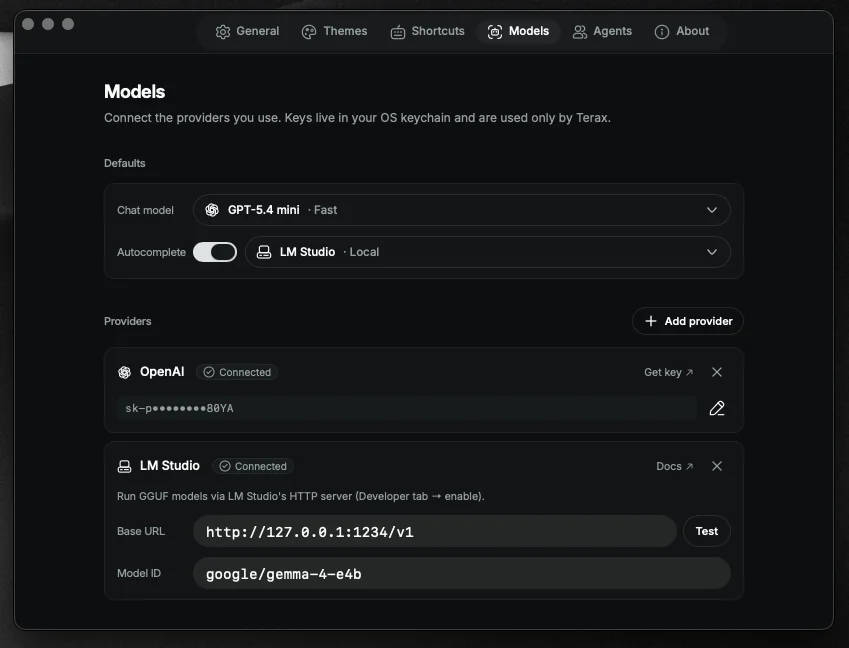
Each provider has its own card in Settings -> Models. Paste a key, pick a model, done.
Local and offline
Key-optional, model id supplied at runtime:
- LM Studio - default base
http://127.0.0.1:1234/v1 - MLX - default base
http://127.0.0.1:8080/v1, optimized for Apple Silicon - Ollama - default base
http://127.0.0.1:11434
Override the base URL per provider in Settings. A reachability indicator (lm_ping) verifies the endpoint when you save.
Model picker
The composer's model picker shows your active provider's model registry, plus favorites and recents you can pin.
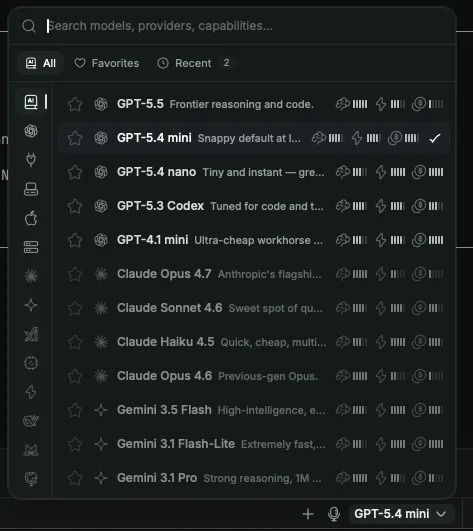
The default model id (DEFAULT_MODEL_ID) and the default autocomplete model (DEFAULT_AUTOCOMPLETE_MODEL) are settable in Settings -> Models.
Key storage
Keys go to the OS keychain via the keyring Rust crate:
- macOS - Keychain (service:
terax-ai) - Windows - Credential Manager (target:
terax-ai) - Linux - Secret Service (libsecret) where available, with a file-based fallback for headless systems
Keys never touch the settings file, localStorage, or env vars. The frontend reads and writes them through the secrets_* Tauri commands.
Switching the active key wipes the in-memory chat map. Saved sessions on disk persist; they re-bind to whichever key is active when you open them.
SSRF guard
All provider HTTP traffic routes through Rust, not directly from the webview. The Rust proxy blocks loopback, link-local, and private-range addresses unless the request is explicitly local-provider scoped. AI tool calls cannot exfiltrate to an attacker-controlled internal host through a poisoned prompt.